



How Close Should A Grow Light Be To Plants?
There is no single distance that works for every grow light and every crop. For commercial growers, indoor farm operators, greenhouse project buyers, and cultivation equipment distributors, the better question is: how close can the grow light be while still giving the crop even, useful, and safe light across the whole canopy?
If the light is placed too close, plants may show stress, leaf curling, bleaching, or uneven growth. If it is too far away, the canopy may not receive enough intensity, and growers may spend electricity without getting the expected crop response. In B2B cultivation projects, wrong hanging height can turn into slower growth, uneven batches, wasted power, and more adjustment work after installation.
Distance Should Start From The Crop Stage
Young plants do not need the same light intensity as mature plants. Seedlings and rooted cuttings usually need a gentler light environment because their leaves and root systems are still developing. During vegetative growth, plants can usually handle stronger light if temperature, airflow, nutrients, and watering are controlled well. Flowering or fruiting crops often need higher light levels, but the canopy must still be watched carefully.
This is why fixed-distance advice can be risky. A grow light that works well at one height for leafy greens may be too strong for young plants. The same height may be too weak for a dense flowering canopy. Commercial buyers should plan hanging height according to crop type, growth stage, planting density, and target yield.
High-Output Grow Lights Need A Layout Plan
A powerful grow light should not be placed by guesswork. The higher the output, the more important the layout becomes. Buyers need to consider fixture spacing, mounting height, canopy size, dimming plan, airflow, and whether the light is used for full indoor cultivation or greenhouse supplemental lighting.
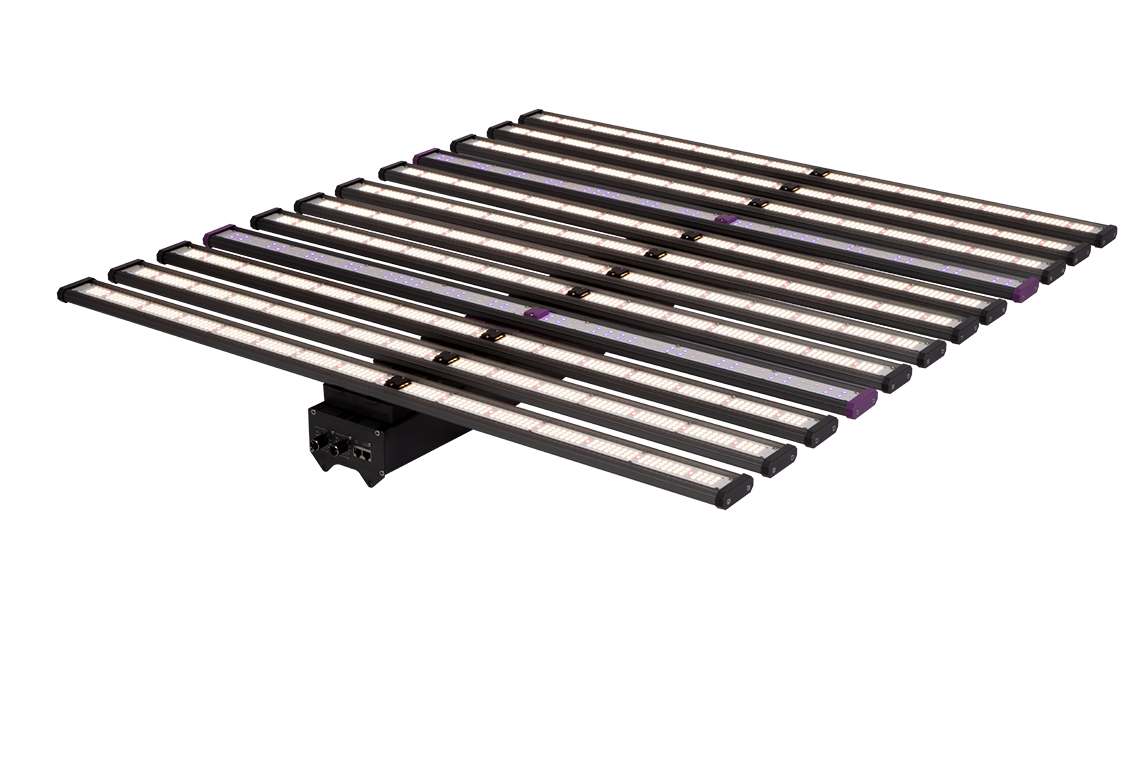
We are AURG, and our COMB-1060 grow light is designed for advanced cultivation projects, with full spectrum output, 3180 µmol/s PPF, 3.0 µmol/J efficacy, and 1060W input power. For commercial growers, this level of output should be matched with a proper installation plan, not simply installed as low as possible above the plants.
A high-output fixture can support strong canopy lighting, but only when the distance and spacing are matched to the growing area. If fixtures are too close or poorly spaced, the center may receive too much intensity while the edges remain weak. That creates uneven plant growth and makes crop management harder.
Watch The Canopy, Not Only The Fixture Height
Grow light distance should be checked from the plant canopy, not only from the floor or ceiling. As plants grow taller, the distance between the light and the top leaves changes. If the hanging height is not adjusted or planned with enough clearance, the canopy may move too close to the fixture over time.
Growers should watch plant response during each stage. Common warning signs include leaves curling upward, pale patches, dry leaf edges, or plants leaning away from the light. If these signs appear near the center of the light footprint but not at the edges, the fixture may be too close or the intensity may need adjustment.
In commercial grow rooms, a PAR meter or PPFD map is more reliable than visual judgment alone. It helps the grower see whether the canopy receives balanced light instead of guessing from brightness.
Uniformity Matters More Than Maximum Intensity
Many buyers focus on the strongest number a grow light can produce. In real cultivation, uniformity often matters more. A crop batch grows better when plants receive a more consistent light level across the canopy. If some plants receive too much light and others receive too little, harvest timing and product quality become harder to control.
For indoor farms, greenhouse benches, vertical grow areas, and commercial cultivation rooms, hanging height should support both intensity and coverage. Raising the fixture slightly may reduce peak intensity, but it can improve spread. Lowering the fixture may increase center intensity, but it can create hot spots or uneven growth.
This balance is important for buyers comparing grow lights. A good installation plan should help the grower use the light efficiently across the full growing area, not only under the center of the fixture.
Power Planning Should Be Checked Early
Grow light distance is connected with energy use. If lights are placed too high, growers may increase power to compensate. If lights are too low, growers may need to dim them or deal with plant stress. Either situation can affect operating cost.
The COMB-1060 supports 100–277V input voltage, which can help project buyers adapt to different electrical environments. Still, power layout should be reviewed before installation. Commercial buyers need to confirm circuit capacity, fixture quantity, daily lighting hours, and heat management. Hanging height is only one part of the whole lighting plan.
Conclusion
A grow light should be close enough to deliver useful light, but not so close that it causes stress or creates uneven canopy growth. The right distance depends on crop stage, fixture output, canopy size, mounting height, spacing, airflow, and the grower’s production target.
For commercial cultivation projects, the safest approach is to plan the lighting layout before installation. Check the crop type, canopy area, fixture spacing, expected light level, voltage condition, and available hanging height first. Then the grow light can be positioned with a clearer purpose instead of relying on rough distance advice.
If your project is choosing grow lights for an indoor farm, greenhouse, or cultivation room, we can help review the canopy size, mounting height, crop stage, power condition, and target lighting layout before bulk ordering. A better distance plan can help the grower avoid weak edges, stressed plants, and wasted energy after installation.
Previous: Do LED Lights Help Plants Grow?
Next: Do Plant Lights Work?